

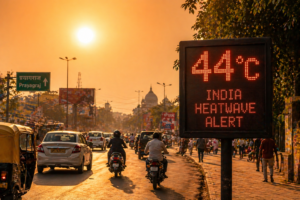
On April 24, 2026, at 5:00 PM IST, real-time data from AQI.in showed 95 of the world’s 100 hottest cities were located inside India. Not in the Sahara. Not in the Gulf. In India.
Temperatures across central India and the Indo-Gangetic plains had crossed 40 degrees Celsius in dozens of cities, with several locations in Uttar Pradesh, Maharashtra, and Odisha edging toward 45 degrees. The states most prominently featured in the global rankings were Maharashtra, Telangana, Madhya Pradesh, Uttar Pradesh, and Odisha.
This ranking did not stay that way for a few hours. It reflects a pattern that has been building across the last week of April, with India’s presence in the global top 100 expanding steadily as the heat dome over the subcontinent deepens.
Before getting into what is causing this and where it is heading, one thing needs to be stated clearly: these rankings are real-time snapshots that fluctuate hourly based on live temperature readings. The 95 out of 100 figure is a specific reading taken at a specific moment. What does not fluctuate is the underlying trend. For several consecutive days in late April 2026, India has not just appeared in the global heat rankings. It has dominated them.
The Cities Nobody Is Talking About
When India’s heat makes news, the coverage typically focuses on Delhi and Rajasthan. Both states have the brand recognition that drives headlines, and both have historically recorded the country’s highest temperatures.
Here is what is unusual this April: neither Delhi nor Rajasthan is at the top of the list.
As of April 21, the hottest cities in the world were Bhagalpur in Bihar, Talcher in Odisha, and Asansol in West Bengal, all recording 44 degrees Celsius. Banda in Uttar Pradesh reached 44.2 degrees, the highest individual reading in the country that day. Prayagraj, Moradabad, Ghazipur, and Varanasi in Uttar Pradesh were all recording temperatures around 44 degrees Celsius by April 24.
Delhi, despite receiving a yellow heatwave alert from the India Meteorological Department, had its maximum temperature at 38.8 degrees Celsius, technically above normal but not even close to the worst-affected cities.
This geographic spread matters because Bihar, eastern Uttar Pradesh, West Bengal, and Odisha are not cities built to manage sustained extreme heat. They have fewer hospitals per capita, less access to air-conditioned public spaces, a higher proportion of outdoor labourers, and in many districts, no local Heat Action Plan at all. The cities making global headlines for their temperatures are, in many cases, exactly the places least equipped to handle what those temperatures mean in human terms.
What a Heat Dome Actually Does and Why This One Is Harder to Break?
Several explanations of this heatwave have described a “heat dome” as though it is simply very hot weather that arrived and will eventually leave. The mechanics behind it explain why relief is unlikely to come quickly.
In early April, a Western Disturbance, a weather system originating near the Mediterranean Sea and travelling through Iran and Afghanistan into India, pushed into the northwest. The jet stream bent into a U-shape and directed moisture into parts of northern India, causing brief unseasonal rain and hailstorms in sections of Uttar Pradesh. Temperatures dropped temporarily. That temporary relief is part of why what followed was worse.
When a Western Disturbance weakens, it leaves behind a low-pressure void. High pressure then fills that void and pushes air downward toward the surface. Descending air cannot form clouds. Without cloud cover to block solar radiation, the ground absorbs heat throughout the day. Without incoming cooler air systems, nighttime temperatures do not fall enough to allow meaningful recovery. Meteorologists call this process subsidence.
As subsidence intensifies, the high-pressure system above strengthens. This creates what scientists call a heat dome: a mass of hot air trapped near the surface by a cap of high atmospheric pressure approximately five kilometres above the ground. The hotter the surface becomes, the stronger the high-pressure cap above it grows, making the system self-reinforcing. Rainfall is suppressed. Skies stay clear. And the cycle continues until an external weather system, either a new Western Disturbance or the advance of the monsoon, is strong enough to break it.
This particular heat dome has been building since mid-April. It does not break simply because days pass. It breaks when atmospheric conditions change, and there is currently no strong system on the immediate horizon capable of disrupting it across the full affected area.
The Numbers That Explain Why This Is an Economic Emergency, Not Just a Health Event
Most reporting on India’s heatwave focuses on temperature readings and health warnings. The economic dimension receives far less attention, but the numbers involved are significant enough to warrant inclusion in any serious treatment of this topic.
According to estimates from the Lancet Countdown India 2024 report, India lost 181 billion potential labour hours to heat exposure in 2023 alone. That translates to approximately 141 billion US dollars in potential income losses, with agriculture accounting for the heaviest share.
The Reserve Bank of India, citing World Bank projections, has noted that up to 4.5 percent of India’s GDP could be at risk by 2030 due to lost labour hours from extreme heat and humidity. India could account for 34 million of the projected 80 million global job losses from heat-stress-related productivity decline by that year.
The connection to what is happening right now is direct. When the temperature crosses 35 degrees Celsius, measurable declines in both physical and cognitive performance begin. For every degree above that threshold, labour productivity drops by roughly two percent. At 44 degrees Celsius, which describes numerous Indian cities throughout this week, a construction worker, a field labourer, or a delivery worker is not operating at normal capacity. They are either working at significantly reduced efficiency, taking dangerous risks, or stopping work entirely.
Informal workers, who make up roughly 81 percent of India’s workforce, have no paid sick leave, no employer-provided cooling facilities, and no financial cushion when heat forces them to stop working. The daily economic damage of a week like this one is structural and largely invisible in official statistics.
What Ahmedabad Got Right That Most Cities Still Have Not Copied
In May 2010, Ahmedabad experienced a heatwave that peaked at 47 degrees Celsius. On the hottest day, the city’s daily death rate from all causes rose from its baseline of roughly 100 to more than 300. Researchers at Gujarat’s public health institute documented the spike, and the city acted.
Ahmedabad became the first city in South Asia to implement a comprehensive Heat Action Plan. What followed was not a complex or expensive set of interventions. It was a coordinated combination of small, practical steps that compounded into significant protection.
Hospitals introduced dedicated heat wards with trained medical staff. A colour-coded early warning system was developed that could give up to five days’ notice before a heatwave, triggering inter-agency coordination across hospitals, emergency services, community groups, and media outlets before conditions became critical rather than after.
Over 100 government buildings had their roofs coated with heat-reflective white paint. Slum areas received the same treatment using innovative materials made from coconut husk and recycled paper waste, making the cooling accessible to residents who could not afford conventional solutions. Mist sprinklers were installed at traffic signals. Buttermilk distribution was organized at public points during peak heat hours, continuing a traditional local practice through formal channels.
Epidemiologists studying the plan’s outcomes concluded it has helped avert more than 1,000 deaths annually. A World Bank study found that extreme heat early warning systems paired with an inter-agency response plan deliver benefit-to-cost ratios exceeding 50 to 1.
The National Disaster Management Authority adopted Ahmedabad’s model as a blueprint and shared it with over 100 cities across India. The uncomfortable reality in April 2026 is that in most of the cities currently topping global heat rankings, those plans either do not exist or exist primarily on paper.
Why Nights Matter More Than Days
The public conversation about India’s heatwave focuses almost entirely on daytime maximum temperatures. The health case for paying equal attention to night-time minimums is strong and underreported.
According to a report from the Council on Energy, Environment and Water, warm nights in Indian cities increased by 32 percent over the past decade. In February 2026, nighttime temperatures across 31 states and Union Territories were at least one degree above normal. In 22 of those states, they were three to five degrees above normal.
Cities in the Indo-Gangetic plains that were historically dry and therefore more bearable at night are now recording humidity levels 10 percent higher than a decade ago. Higher humidity prevents sweat from evaporating, which disrupts the body’s primary cooling mechanism. A night temperature of 32 degrees Celsius with 60 percent humidity can be physiologically more dangerous than a dry 36 degrees because the body cannot cool down at all.
The medical consequence is cumulative. By day five or six of a sustained heatwave with warm nights, the risk of serious heat-related illness rises sharply even for people who stayed indoors during the day. The body needs several hours of lower core temperature during sleep for physiological restoration. When that window disappears for multiple consecutive nights, the effects compound.
This is relevant right now because the current heat dome is suppressing nighttime cooling across much of central and northern India. The pattern will continue as long as the dome remains in place.
Delhi’s Schools and What It Tells You About the Scale of This
One detail from this week captures the seriousness of the situation better than any temperature reading.
On April 22, the Delhi government issued emergency guidelines requiring all schools in the city to implement a water bell system: a bell rung every 45 to 60 minutes during school hours r, reminding students to drink water. Outdoor morning assemblies were moved indoors or cancelled entirely. Open-air classes were prohibited. A buddy system was introduced pairing students with each other to monitor physical well-being. Delhi Chief Minister Rekha Gupta directed all schools to submit compliance reports to the Directorate of Education by May 2.
These are not suggestions. They are mandatory directives covering both government and private schools. The fact that a major Indian city needed to formally instruct schools to remind children to drink water at regular intervals is, in its own quiet way, a precise measure of how far outside normal conditions this heatwave has pushed daily life.
What El Niño Means for May and June
The World Meteorological Organization confirmed on April 24 that El Niño conditions are expected to return between May and July 2026, with early signs suggesting a potentially strong event.
El Niño is the periodic abnormal warming of the central and eastern equatorial Pacific Ocean that recurs every four to seven years and reshapes weather patterns globally. When active over the Indian subcontinent, it typically weakens the southwest monsoon, reducing the rainfall that most of India depends on for temperature relief between June and September.
The IMD’s April to June 2026 seasonal forecast has already projected above-normal heatwave days across eastern, central, and northwest India, with night-time temperatures expected to remain three to five degrees above normal nationally. Regions specifically identified as likely to face above-normal heat in the coming weeks include Odisha, West Bengal, Tamil Nadu, coastal Andhra Pradesh, Gujarat, Maharashtra, and parts of Karnataka.
If El Niño strengthens through June as current models project, the monsoon that represents the primary escape from this heat may arrive weaker and less consistent than normal across parts of the country. The window of relief narrows considerably under that scenario.
What You Can Actually Do Right Now
Most heat safety advice distributed during Indian heatwaves is generic to the point of being useless. What follows is specific.
The safe outdoor window in most affected cities this week runs from approximately 6 AM to 8 AM and resumes after 7 PM. Outside these windows, temperatures in the worst-affected cities are above levels where outdoor physical exertion carries a genuine health risk. If your schedule allows any flexibility, that is the information that matters most.
Thirst is not a reliable signal for hydration during a heatwave. By the time the body registers thirst, mild dehydration is already present. In conditions above 40 degrees Celsius, adults doing any physical activity need to drink water proactively, not responsively.
If you live in a flat with a tin or concrete roof that absorbs heat, covering the roof surface with white lime wash, which costs almost nothing, can reduce indoor temperatures by two to four degrees. Ahmedabad has demonstrated this at scale. It works.
Fans stop being effective at preventing heat stress when ambient temperatures exceed roughly 35 degrees, and the humidity is high. At that point, the air the fan circulates is too warm to cool the body through convection, and if humidity is also high, sweating cannot evaporate effectively either. Knowing this matters because it changes what interventions are actually useful versus what creates a false sense of safety.
Rural residents with elderly family members should not equate the absence of visible symptoms with safety during a sustained heatwave. Heat exhaustion and heat stroke can develop rapidly in older adults who are not sweating normally, not drinking enough fluids, or sleeping in poorly ventilated spaces. Checking in once a day is not sufficient during a week like this one.
The Honest Assessment of What Comes Next
The current heat dome will eventually break. A new Western Disturbance or the advance of pre-monsoon activity from the Bay of Bengal will eventually disrupt the atmospheric cap holding it in place. Some forecasts indicate the possibility of thunderstorms and gusty winds in parts of eastern and northeastern India in the coming days, which could bring localized temporary relief.
A significant and sustained drop in temperatures across the full affected area is unlikely until the monsoon itself advances substantially into the country. Based on current forecasts, some climate models suggest the southwest monsoon could reach Kerala’s coast as early as May 25, roughly a week ahead of its usual June 1 onset. But the monsoon takes several weeks to advance from Kerala through central and northern India. For the cities currently dominating global heat rankings, meaningful monsoon relief is still weeks away, even under the most optimistic forecast.
In the meantime, India is the hottest place on Earth. Not in the way the phrase is normally used as a loose description of a warm country. In the literal, measured, real-time sense: 95 of the 100 hottest cities recorded on the planet on April 24 were inside its borders.
That is a statistic that warrants more than a weather report.