

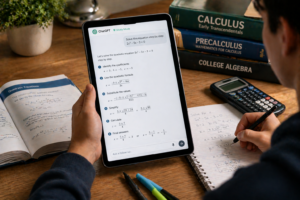
Math is not hard because of the answers. It is hard because of the steps in between.
Most students do not struggle with final results. They struggle with how to get there. That is exactly where modern AI tools are changing the game. Instead of just solving problems, today’s best AI tools break down every step, explain the logic, and guide you like a private tutor.
Some even ask follow-up questions, adapt to your level, and provide multiple solving methods, something traditional calculators never did.
Based on 2026 educational AI reports and student-rated platforms, here are 9 AI tools that act as personal math tutors by breaking down problems into detailed, actionable steps, ranked from 9 to 1.
9. Cymath
Best for: Quick, no-fuss algebra and calculus help
Cymath is a focused math solver built around simplicity. It does not try to do everything — and that is actually its strength. Students type in an equation and receive a clear, step-by-step breakdown without distractions or paywalls getting in the way.
What it does:
- Solves algebra and calculus problems with clear sequential steps
- Explains each operation in plain terms
- Works entirely through a browser with no account required for basic use
- Free tier available; Cymath Plus ($4.99/month) removes ads and unlocks additional explanation depth
Why it is useful: Cymath is ideal for students who want fast, reliable homework help on standard algebra and calculus problems. It is not the most powerful tool on this list, but its algebra engine is rock-solid, and its simplicity makes it one of the easiest tools to pick up and use immediately.
Note: Cymath’s mobile app has not received a significant update since late 2023. The web version remains functional and actively used, but students should be aware the app experience may be limited compared to newer tools.
8. Microsoft Math Solver
Best for: Free, structured step-by-step solutions with visual support
Microsoft Math Solver is a completely free tool that provides clear, sequential solutions across a wide range of math topics. Unlike many free tools, it does not hide steps behind a paywall — the full breakdown is available at no cost.
What it does:
- Solves problems from basic arithmetic through calculus and statistics
- Breaks solutions into clearly numbered, sequential steps
- Generates interactive graphs and visual aids to support understanding
- Accepts both typed input and handwritten/photo-based problems
- Links out to relevant tutorial videos for deeper learning
Why it stands out: There is no subscription required for step-by-step solutions. Microsoft Math Solver is one of the few tools that genuinely serve students who cannot or do not want to pay, without compromising on explanation quality. It also works as a Chrome and Edge browser extension, making it accessible wherever students work.
7. Mathway (by Chegg)
Best for: Wide subject coverage from pre-algebra to advanced calculus
Mathway is one of the most established math solvers available, covering an unusually broad range of subjects, including algebra, trigonometry, calculus, statistics, linear algebra, and finite mathematics.
What it does:
- Solves problems across more math subjects than most tools
- Provides instant answers in the free version
- Unlocks detailed, step-by-step solutions with a paid subscription
- Offers specialized calculators for individual topic areas
Why it is useful: Mathway’s strength is its range. Whether a student is working on pre-algebra homework or a college-level linear algebra assignment, the tool handles it under one roof. The free tier shows final answers, which is useful for quick checking. A subscription unlocks the full step-by-step breakdown.
Transparency note: Mathway is owned by Chegg. The tool functions independently and the acquisition does not affect how it operates for students, but it is worth knowing for context.
6. Symbolab
Best for: Method-focused, step-by-step learning across all math levels
Symbolab is one of the most widely used dedicated math learning platforms available in 2026. It is built specifically around teaching students the method, not just the answer.
What it does:
- Provides detailed, step-by-step breakdowns for algebra, trigonometry, calculus, linear algebra, and statistics
- Explains the reasoning behind each step, not just the operation
- Generates follow-up practice problems on the same concept after solving
- Supports typed input, photo scanning, and a dedicated mobile app
- Available in free and paid tiers (Pro starts at approximately $8.99/month)
Why it stands out: Symbolab closes the loop that most solvers leave open. After it walks you through a solution, it generates practice problems on the same concept so you can test whether you actually understood it. This feedback loop is closer to real tutoring than most tools offer, and it covers math topics from pre-algebra all the way through college-level subjects.
5. Gauthmath (Gauth)
Best for: Hybrid AI and live human tutoring support
Gauthmath, now rebranded as Gauth and developed by ByteDance, is a unique tool that combines AI-powered step-by-step solutions with optional access to live human tutors. This hybrid model makes it one of the most versatile homework helpers for students who sometimes need more than an algorithm.
What it does:
- Scans photos of handwritten or printed problems for instant solutions
- Provides step-by-step explanations across math and 30+ subjects
- Connects students to live, certified human tutors available 24/7 when the AI cannot resolve a problem (typically within 5 to 10 minutes)
- Offers a 100% ad-free experience across all plans, including the free tier
- Free plan includes limited daily solutions; Premium (~$9.99/month) unlocks unlimited AI use; Tutor plan (~$19.99/month) adds live human access
Why it stands out: Most AI tools cannot handle the edge cases, unusual problem formats, complex proofs, or questions that need a human explanation. Gauthmath solves this by routing those problems directly to a live tutor. For students who need reliable help without knowing in advance whether AI will be enough, this hybrid approach is a practical advantage.
4. Mathos AI (formerly MathGPTPro)
Best for: Specialized math accuracy with multi-modal input
Mathos AI is an AI engine built specifically for mathematics, rather than adapted from a general-purpose language model. Its core advantage is specialization. The system is fine-tuned for math problem solving across algebra, calculus, physics, and chemistry.
What it does:
- Provides step-by-step solutions with detailed reasoning across math and STEM subjects
- Accepts photo, voice, text, and PDF input, making it highly flexible
- Includes an interactive graphing tool and smart chat interface for follow-up questions
- Claims higher accuracy than generalist AI models for math-specific tasks (self-reported by the company)
- Pricing starts at $9.99/week
Why it stands out: The multi-modal input, especially voice and PDF, makes Mathos AI genuinely useful during active studying rather than just for typing out problems. It is built for depth, covering engineering and advanced college-level math that many consumer tools do not handle well.
Accuracy note: Mathos AI claims higher accuracy than GPT-4 for math problems based on internal testing. This has not been independently verified by a third-party benchmark. Use it as a strong math-focused tool, but verify important results.
3. Wolfram Alpha
Best for: Computational accuracy and advanced mathematics
Wolfram Alpha is the gold standard for mathematical correctness. Unlike AI chatbots that generate answers based on language patterns, Wolfram Alpha uses a computational knowledge engine, meaning it calculates answers using deterministic algorithms rather than predicting them.
What it does:
- Computes exact, symbolic answers for problems from basic algebra through differential equations, linear algebra, and beyond
- Provides step-by-step solutions (Pro version required for full step display)
- Generates graphs, alternative forms, and detailed derivations
- Handles natural language input; you can type a problem the way you would say it
- Free tier available; Pro starts at approximately $5/month
Why it ranks high: When accuracy matters more than anything else in exams, research, or engineering-level coursework, Wolfram Alpha is the most reliable tool available. It does not hallucinate steps or produce confident wrong answers the way language-based AI can. For students in advanced math or STEM, it is an essential verification tool.
One limitation worth noting: The interface can feel technical and the step-by-step breakdown requires a Pro subscription. It is better suited for students who already have some math foundation than for complete beginners.
2. Khanmigo by Khan Academy
Best for: Genuine tutoring experience using the Socratic method
Khanmigo is Khan Academy’s AI-powered tutor, and it takes a fundamentally different approach from every other tool on this list. It does not give you the answer. Instead, it guides you to find it yourself.
What it does:
- Uses Socratic questioning to walk students through problems, asking guiding questions rather than providing direct answers
- Covers K-12 math through AP Calculus, fully integrated with Khan Academy’s curriculum library
- Adapts to each student’s level and provides hints, not solutions
- Supports math, science, coding, humanities, and test preparation
- Now supports image uploads of handwritten problems
- Available for $4/month or $44/year for learners; completely free for teachers
Why it ranks so high: Khanmigo is the closest thing to a real private tutor that AI currently offers. Independent testing has shown it produces better concept retention than direct-answer tools, meaningfully, precisely because it forces students to engage with the material rather than just copy a solution. Khan Academy founder Sal Khan describes it as “the closest thing to a personal tutor for every student on Earth.”
The $4/month price point also makes it the most affordable structured tutoring experience on this list.
Honest limitation: Khanmigo works exclusively within Khan Academy’s ecosystem, so it cannot directly help with homework from other curricula. Students accustomed to instant answers may also find its question-led approach frustrating at first but that friction is by design, and most students adjust after a few sessions.
1. ChatGPT (OpenAI)
Best for: Versatile, conversational math tutoring across all levels
ChatGPT earns the top spot not because it is the most accurate at raw computation Wolfram Alpha holds that crown but because it is the most complete tutoring experience available for the widest range of students.
What it does:
- Breaks down math problems into logical, clearly explained steps across every level, from school arithmetic to university-level proofs
- Explains concepts in multiple ways until the student understands
- Handles word problems, proofs, and conceptual reasoning, not just equations
- Allows follow-up questions in natural conversation — “Why did you do that step?” gets a real answer
- Study Mode (launched July 2025, free on all plans) uses Socratic questioning to guide students rather than give answers directly
- The o1 and o3 reasoning models offer significantly stronger performance on complex math problems
Why it ranks #1: ChatGPT leads math benchmarks among general AI models in 2026, and its combination of accuracy, adaptability, and conversational ability makes it unmatched for everyday tutoring use. It does not just solve problems it can explain a concept five different ways, generate practice problems, quiz you on what you just learned, and adjust its explanation when you are still confused.
The free tier is functional for most students. ChatGPT Plus ($20/month) unlocks the stronger reasoning models that handle advanced calculus and proofs with notably higher reliability.
One important note: ChatGPT occasionally makes arithmetic errors on complex calculations while being correct about the reasoning. For high-stakes verification of exact answers, cross-check with Wolfram Alpha. The two tools used together ChatGPT for understanding, Wolfram Alpha for verification is the most effective combination available in 2026.
The Bottom Line
There is no single perfect tool. The right choice depends on what you actually need in the moment.
If you are stuck on a homework problem at midnight and need fast, reliable steps, Photomath or Microsoft Math Solver gets the job done without any friction. If you are preparing for an exam and want to genuinely understand the material rather than just see the answer, Khanmigo and ChatGPT Study Mode will serve you far better in the long run. If you are in university-level math and need answers you can actually trust, Wolfram Alpha is still the most reliable engine available.
The shift that matters most in 2026 is not which tool is fastest. It is which tool builds understanding rather than dependence? The students who use these tools to learn the method, not just copy the result, are the ones who actually improve. An AI that explains why a step works is worth ten that just show you what the answer is.
That is the difference between a calculator and a tutor. The best tools on this list know it too.