

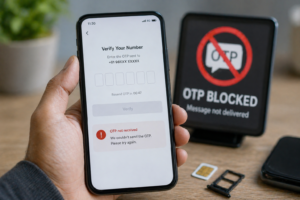
One-time passwords (OTPs) are now a critical layer of authentication across banking, government services, and everyday apps in India. When they suddenly stop arriving, the impact is immediate. Access to payments, logins, and identity-linked services can be disrupted without warning.
What makes this issue confusing is that OTP failures rarely come from a single cause. They happen when something breaks across a chain of systems that includes the service sending the OTP, telecom infrastructure, regulatory filters, and the user’s own device. Once you understand how that chain works, the problem becomes easier to diagnose.
The Delivery Chain: Where OTPs Can Fail
An OTP is not just a message. It travels through a layered system:
| Stage | What Happens | Where It Can Fail |
|---|---|---|
| Generation | Service (bank/app) creates OTP | Server overload, rate limiting |
| Aggregation | Phone receives and displays a message | Routing errors, provider outages |
| Compliance | Message checked against regulatory templates | DLT rejection, sender ID issues |
| Telecom Delivery | Operator routes SMS to SIM | Spam filters, storage, and p issues |
| Device Reception | Spam filters, storage, and p issues | Spam filters, storage, app issues |
Even if one layer fails silently, the OTP may never reach you.
Why OTPs Fail Even When Everything Looks Normal?
SIM Status and Network-Level Restrictions
A common cause is the SIM not being fully active at the network level. If a SIM has expired validity, is partially restricted, or has not been properly provisioned for SMS services, OTP delivery can fail. In some cases, operators allow a short grace period where incoming SMS may still work, but this is not guaranteed and varies by provider.
Signal strength also plays a role. Weak coverage, indoor locations, or temporary outages can delay OTPs. Unlike normal SMS, OTPs are often time-sensitive and may expire before delayed delivery becomes useful.
Regulatory Filtering and Template Mismatches
India’s telecom ecosystem applies strict filtering through frameworks regulated by the Telecom Regulatory Authority of India. Businesses must register message templates under Distributed Ledger Technology (DLT) systems.
If an OTP message:
- does not match its approved template
- comes from an unregistered sender ID
- Ors roit uted through an unverified channel
It can be blocked before it even reaches the telecom network.
Do Not Disturb (DND) settings generally do not block OTPs, since they are classified as transactional messages. However, rare misclassification or filtering errors can still interfere.
Carrier Spam Filters and Sender Reputation
Telecom operators use automated systems to detect spam and fraud. OTPs are typically sent through short codes or enterprise sender IDs, which are monitored more strictly than regular numbers.
If a sender triggers spam detection, sends too many OTPs in a short time, or has a poor reputation score within the operator’s system, messages may be delayed or silently blocked. This can happen even if the service itself is functioning correctly.
Aggregator and Routing Failures
A less visible but increasingly common issue lies between the service and the telecom network. Most companies do not send SMS directly. They rely on SMS aggregators.
If the aggregator:
- experiences downtime
- routes messages incorrectly
- or fails to hand off messages to telecom operators
The TP may never enter the delivery network at all. From the user’s perspective, it appears as if the SIM is not receiving messages, when in reality the message was never delivered into the system.
Device-Level Filtering and Configuration Issues
Sometimes the OTP is delivered but not visible.
Modern smartphones include multiple layers of filtering:
- built-in spam detection in SMS apps
- blocked sender lists
- third-party security or spam apps
- Incorrect default messaging app settings
Storage also matters. A full SMS inbox or low device storage can prevent new messages from appearing.
Dual SIM phones introduce another layer of confusion. OTPs may arrive on the secondary SIM or be associated with a different default messaging line, making them easy to miss.
Network Mode and Temporary Registration Issues
Short-term technical glitches can also interfere:
- switching between 4G and 5G networks
- VoLTE-related registration issues
- airplane mode toggling or network resets
These can temporarily disconnect the device from the SMS network even if signal bars appear normal.
Service-Side Limits and Security Controls
The service sending the OTP can also block delivery under certain conditions:
- Too many OTP requests in a short period
- suspicious login or transaction patterns
- server overload during peak demand
In some cases, banks or apps may deliberately delay or block OTPs as a security measure rather than a technical failure.
Roaming, Porting, and Number Lifecycle Issues
Users outside their home network may face additional challenges:
- Incoming MSay fails without an active roaming plan
- International MSoutes may be filtered by operators
After mobile number porting (MNP), SMS routing can take 24 to 72 hours to stabilise.
A more serious risk is number reassignment. If a number is deactivated and later reassigned to another user, OTPs may be delivered to the new SIM instead.
What This Means in Real Life
When OTPs stop arriving, the impact goes beyond inconvenience. Access to banking, identity services, and secure logins can be blocked instantly.
More importantly, repeated OTP failure is not always harmless. While most cases are technical, persistent failure can sometimes indicate deeper issues such as SIM deactivation, routing errors, or, in rare situations, SIM swap activity. It is not proof of fraud, but it is a signal worth investigating.
Quick Diagnostic Table
| Symptom | Most Likely Cause |
|---|---|
| No OTPs at all | SIM inactive, network restriction |
| Delayed OTPs | Network congestion or weak signal |
| Some services work, others don’t | DLT or sender compliance issue |
| OTP not visible but expected | Device filtering or storage issue |
| OTPs stopped after SIM change | SIM provisioning or routing issue |
| Works on another phone | Device-specific problem |
What You Can Check Immediately
If OTPs suddenly stop, a few quick checks can help isolate the issue:
- Confirm the IMs are active and recharged
- Check the signal strength and try moving outdoors
- review spam or blocked message folders
- ensure storage is not full
- Test the SIM in another phone
- Avoid repeated OTP requests within a short time
If the issue continues across multiple services, contacting your telecom operator is usually necessary.
FAQs
1. Why do OTPs fail even when normal SMS works?
Because OTPs go through stricter routing, filtering, and compliance checks. Regular SMS does not face the same level of scrutiny.
2. Can DND settings block OTPs?
No, DND is designed to block promotional messages, not transactional OTPs. However, rare filtering errors can still affect delivery.
3. How long does it take for OTPs to work after porting a number?
Typically, up to 72 hours. During this period, SMS routing may be unstable.
4. Can a damaged SIM stop OTPs?
Yes. Physical damage or improper configuration can affect SMS reception.
5. Is OTP failure a sign of SIM swap fraud?
Not necessarily. Most cases are technical. But persistent unexplained failure should be checked with your operator.
6. Why do OTPs sometimes arrive late?
Network congestion, routing delays, or temporary outages can delay delivery, making the OTP expire before use.
Conclusion
When a SIM suddenly stops receiving OTPs, the problem is rarely random. It is usually caused by a breakdown somewhere in a multi-layer system that includes service providers, SMS gateways, regulatory filters, telecom operators, and the user’s own device.
The key insight is simple: OTP delivery depends on coordination across all these layers. If even one fails, the message may never arrive. Understanding this makes it easier to identify the cause, respond appropriately, and restore access without unnecessary confusion.
Also Read: One Wrong Permission Can Expose Banking OTPs! Act Before It’s Too Late