

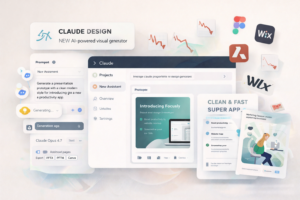
Anthropic launched a new product on April 17, 2026, called Claude Design, an AI tool that generates visual outputs, including prototypes, presentations, marketing assets, and one-pagers from text prompts. The product is powered by the company’s Claude Opus 4.7 model and is available as a research preview for users on Pro, Max, Team, and Enterprise subscription plans at no additional cost.
The launch drew attention not just for what the tool does, but for what happened before it was even announced.
What Happened Before Launch
On April 14, three days before the product went live, Anthropic’s Chief Product Officer Mike Krieger quietly resigned from the board of Figma, the publicly traded interface design company. The resignation was disclosed to the US Securities and Exchange Commission the same day that The Information reported Anthropic’s next model would include design tools that could compete directly with Figma’s core business.
Figma’s stock dropped around 6% on that news alone. When Claude Design officially launched two days later, Figma fell a further 7% in a single session. Adobe dropped roughly 2.7%. Wix fell 4.7%. GoDaddy declined 3%.
Krieger had co-founded Instagram and later built Artifact, an AI news app acquired by Yahoo in 2024, before joining Anthropic as CPO in 2024 and taking a Figma board seat less than a year ago. His departure at the exact moment Anthropic moved into design territory made the competitive intent difficult to misread.
Anthropic told TechCrunch that Claude Design is intended to complement tools like Canva rather than replace them. That may be true for Canva. The relationship with Figma now looks considerably more complicated.
What Claude Design Actually Does
The tool works in a sidebar-style interface at claude.ai/design. You describe what you want, Claude generates a first version, and you refine from there through conversation, inline comments, direct edits, or sliders for spacing, color, and layout.
It supports importing documents in DOCX, PPTX, and XLSX formats, uploading images, and using a web capture tool to pull elements directly from a live website so that prototypes can resemble an actual product rather than a blank template.
During an onboarding setup, Claude reads a company’s existing codebase and design files to build a design system covering colors, typography, and components. Every project created after that is supposed to automatically reflect those brand rules. Teams can maintain more than one design system.
Outputs can be exported as PDF, PPTX, standalone HTML, or shared as an internal link within an organisation. Designs can also be sent directly to Canva, where they become fully editable in Canva’s interface. There is a direct handoff to Claude Code: when a design is finished, Claude packages it into a bundle that Claude Code can receive with a single instruction to begin building the actual product.
Collaboration is built in. Projects can be kept private, shared for viewing across an organisation, or opened for editing so multiple team members can work on a design and chat with Claude together.
For Enterprise plans, Claude Design is turned off by default. Administrators need to enable it in Organisation settings.
Who Anthropic Says It Is For
Anthropic frames the tool as serving two audiences.
The first is people without design backgrounds: founders who need a pitch deck, product managers sketching feature flows, marketers building campaign visuals. The pitch is that they can produce a usable draft without touching a design tool.
The second is experienced designers who want to explore more directions faster. Anthropic points to Brilliant, an education technology company, as an early user. The company’s product team reported that pages requiring more than twenty prompts to recreate in other tools needed only two in Claude Design. That is a single data point from a company that was given early access, and independent verification does not yet exist.
Read More: AI Edits Your Word Docs Now – But There’s a Catch
What Is Still Unproven
Claude Design launched as a research preview, which means it is explicitly not a finished product. That label carries real weight here.
The design system integration is only as good as the quality of the codebase and design files that a team hands it. For organisations with clean, documented systems, the automatic brand application could save meaningful time. For teams with messy or inconsistent files, Claude reading those files and applying them automatically is as likely to produce inconsistent results as consistent ones.
The tool competes in a market where Figma has roughly 80 to 90 percent UI and UX market share with a mature plugin ecosystem, years of trust from professional design teams, and collaboration workflows that have been tested at scale. Claude Design is days old.
The Claude Code handoff is positioned as a key differentiator: the ability to move from text prompt to visual prototype to production code without leaving the Anthropic ecosystem. That workflow is only useful if an organisation already uses Claude Code. For teams using other development tools, that particular feature means nothing.
No independent user testing or third-party evaluation of Claude Design’s output quality has been published at the time of writing. Anthropic’s own marketing materials and early access partners are the only sources of performance claims.
There is also a subscription limit question worth noting. Adding Claude Design usage to an existing subscription counts against the same limits that already govern other Claude usage. Anthropic has faced user criticism in 2026 over tighter usage limits, with paid subscribers reporting that context-heavy sessions drain allowances faster than expected. A tool that generates complex visual outputs could accelerate that problem for heavy users.
The Broader Market Question
The stock reaction to Claude Design’s launch reflects something bigger than one product. Investors are pricing in the possibility that AI tools are moving into professional software categories that were previously considered difficult to automate. Design is one of them.
Whether Claude Design specifically justifies that reaction depends on questions that a research preview launch cannot answer. Does the output quality hold up under real professional workloads, not just curated demos? Does the design system integration work reliably across organisations with complex existing setups? Does the tool improve at a pace that closes the gap with established platforms?
The fact that a text description can produce a usable visual draft is real. Whether that capability, in its current form, meaningfully disrupts professional design workflows in the way the market reaction implied is a different question. Both things are worth holding in mind separately.
The Basic Facts
Claude Design is available now at claude.ai/design for Pro, Max, Team, and Enterprise subscribers. It is a research preview. It is included in existing subscription pricing. Enterprise organisations need an admin to enable it. More information can be found at Anthropic’s official launch page.
Also Read: 10 AI Tools Every STEM Student Should Know About in 2026