
You Might Stop Logging In Without Even Realizing It
For years, logging into apps has followed the same pattern. Enter a password, scan a fingerprint, or verify with a code. It works, but it always interrupts what you are doing.
Researchers led by Rutgers University are exploring a very different idea. What if authentication did not require any action at all?
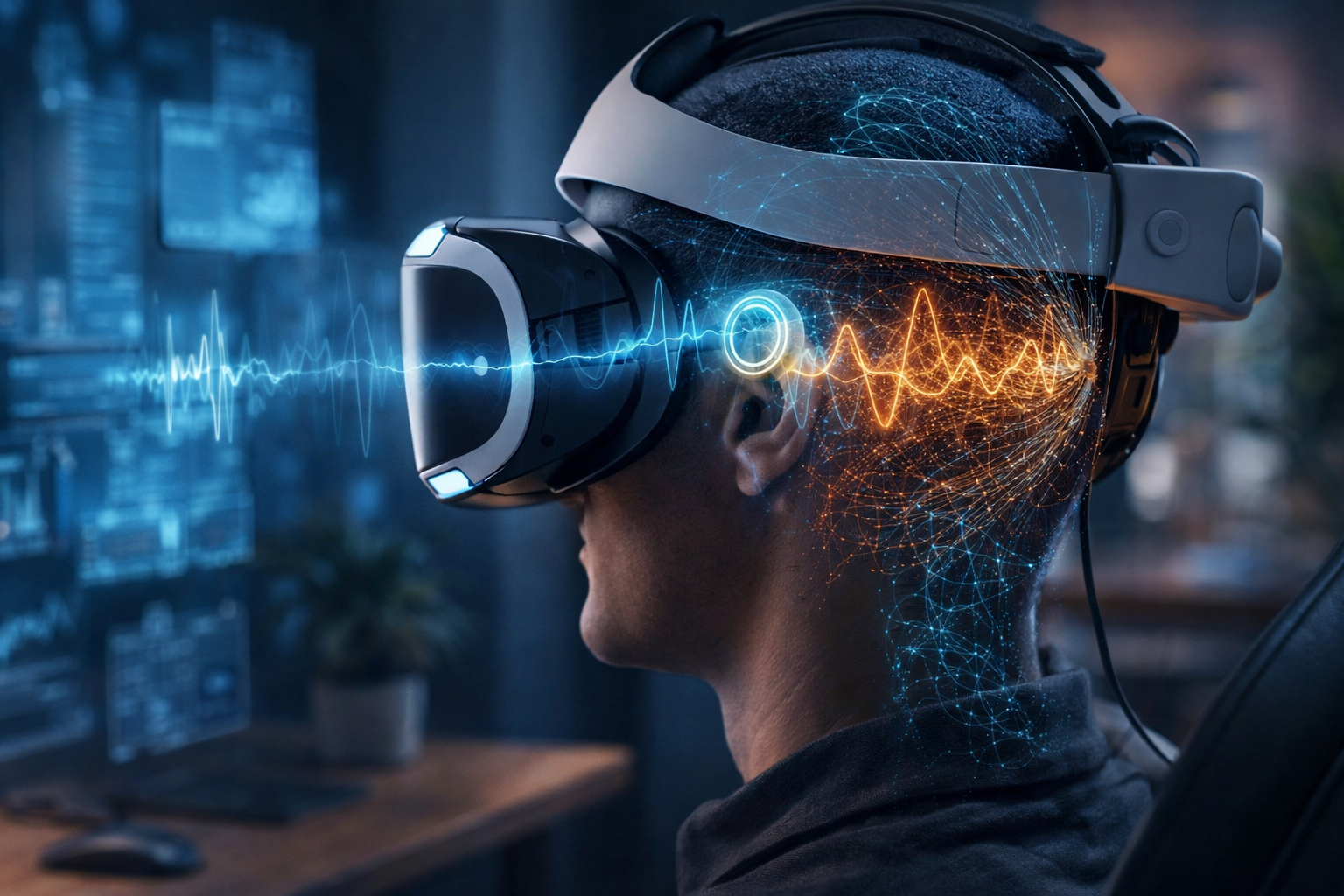
Their system, called VitalID, does not ask you to prove who you are. It quietly figures it out by reading tiny vibrations inside your skull.
Your Body Is Already Generating a Password
Even when you are completely still, your body is not. Every breath and every heartbeat creates small vibrations. These travel through your neck and into your skull, where they behave slightly differently depending on your bone structure and facial tissue.
VitalID captures these patterns using sensors already built into XR headsets. Since no two skulls are identical, the vibration pattern becomes a unique identifier. This is what makes the idea powerful. It is not adding a new step. It is using something that is already happening.
The Important Detail Most People Miss
This is not just another biometric, like a fingerprint or face scan. VitalID works continuously.
Instead of verifying you once and trusting that nothing changes, it keeps checking in the background. The system can confirm that the same person is still using the device without interrupting the experience. That small difference changes how authentication works at a fundamental level.
Why This Exists in the First Place
This system is built for extended reality environments. Devices like Meta Quest and Oculus Rift are becoming more common, and they are starting to handle more than just games.
People are using them for meetings, training, financial tools, and even accessing sensitive data. The problem is that logging in to these environments is awkward. Typing with gestures is slow. Two-factor authentication breaks immersion. Taking off the headset defeats the purpose.
VitalID solves that specific problem. It lets authentication happen without interrupting the experience.
What Real Usage Could Look Like
The easiest way to understand this is to imagine normal situations:
You put on your headset and immediately enter your workspace without logging in. While you are inside a virtual meeting, the system keeps verifying your identity without you noticing.
If someone else picks up your headset, access quietly stops or changes without requiring a manual logout. This is not about faster login. It is about removing login entirely from the user’s perspective.
Where It Gets Interesting Beyond the Obvious
The most interesting impact is behavioral.
When authentication disappears, people stop thinking about security as a separate step. It becomes part of the environment itself.
That sounds ideal, but it creates a new kind of risk. When users do not see security happening, they may not realize when something goes wrong. This makes transparency and system feedback just as important as accuracy.
What the Testing Actually Shows
The system has been tested across 52 participants over a period of 10 months.
- More than 95 percent accuracy for identifying the correct user
- More than 98 percent success in rejecting unauthorized users
Researchers also built filtering systems to ignore larger movements like nodding or shifting position. The goal is to isolate only the tiny biological signals that matter.
These results are promising, but still come from controlled conditions rather than messy real-world environments
Why It Is Hard to Fake but Not Impossible
VitalID has a strong advantage over traditional biometrics. Fingerprints and faces exist on the surface. They can be copied with enough effort. Skull vibration patterns come from inside the body and depend on physical structure. That makes them much harder to replicate.
However, no authentication system is perfect. Advanced attacks or sensor manipulation are always possible in theory. The strength here is increased difficulty, not absolute security.
A Practical Way to Think About It
If you are planning to write about or eventually use systems like this, a few practical points matter more than the headline.
- This works best in controlled hardware environments like XR headsets
- Sensor quality will directly affect accuracy
- Continuous authentication means constant data processing, which raises privacy questions
- It is not a universal replacement for passwords yet
Understanding these limits makes the technology easier to evaluate realistically.
The Privacy Trade-Off Few People Talk About
There is a subtle issue that does not get enough attention: Passwords can be changed. Most biometrics cannot.
If a system based on internal biological signals is ever compromised, replacing that identity is not straightforward. At the same time, because the signal comes from inside the body, it is harder to capture or steal compared to external biometrics.
This creates a trade-off between long-term security and recoverability that will need careful handling if the technology becomes mainstream.
Where Things Stand Right Now
VitalID is still in the research stage. It has been presented at a major security conference and is backed by a provisional patent. The team is open to licensing and collaboration, but there is no commercial rollout yet.
That means this is not something you can use today. It is a glimpse of where authentication might be heading.
Why This Matters More Than It Seems
Most improvements in security add friction. More steps, more verification, more effort from the user. VitalID moves in the opposite direction. It removes steps instead of adding them.
That is a bigger shift than it looks. The future of authentication may not be about stronger passwords, but about removing the need for them entirely.
FAQs
1. Is VitalID available to use right now?
No. It is currently a research project and has not been released as a commercial product.
2. Does it eliminate passwords?
Not yet. It is designed for XR environments and could reduce reliance on passwords in those systems if adopted.
3. How is it different from fingerprint or face unlock?
It uses internal vibration patterns from your skull, which are harder to replicate and can be monitored continuously rather than just once.
4. Can someone fake this kind of authentication?
It is much harder to fake compared to traditional biometrics, but no system is completely immune to advanced attacks.
5. Why is this important for the future of technology?
As immersive systems handle more sensitive data, authentication needs to become seamless. VitalID shows a path where security works in the background without interrupting the user.
This article is based on publicly available research by Rutgers University researchers. All facts, statistics, and claims reflect information from the official research release and published coverage. This is not medical or security advice.