
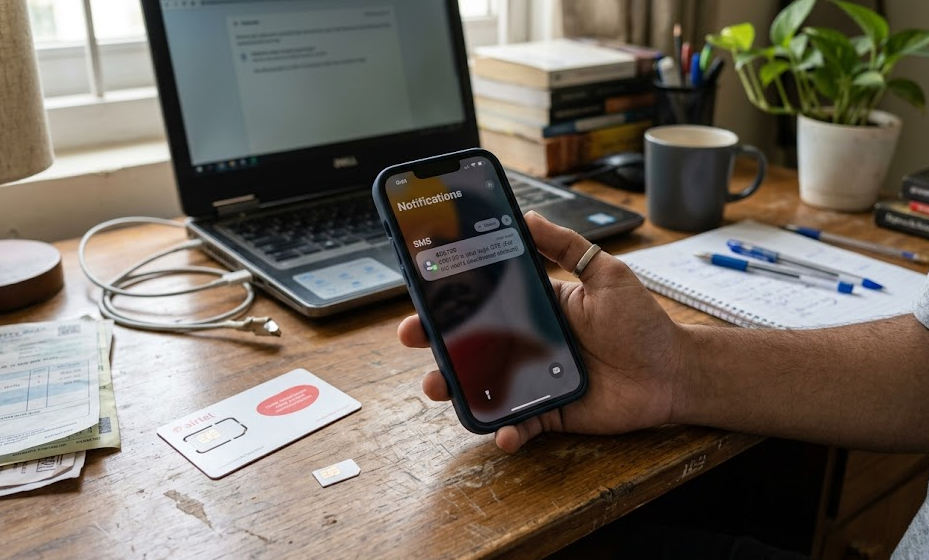
Mobile numbers in India are not permanently tied to one user. When a SIM becomes inactive or is disconnected, telecom operators can reassign that number to someone else after a waiting period. This is a standard industry practice, but it creates a lesser-known digital risk.
Because phone numbers are widely used for logins, password resets, and one-time passwords (OTPs), a recycled number may remain linked to the previous owner’s online accounts if not updated.
This raises a key question: If your old number is reassigned, who can access your accounts, and how?
Here we will talk about s what is verified, what is often misunderstood, and what users should realistically expect, based on current systems and safeguards.
What Is Actually Known:
1) Phone numbers are routinely recycled
In India, telecom operators are allowed to reassign deactivated numbers after a gap. In practice, numbers usually go through a cooling-off period of around 60–90 days (or sometimes longer) before reassignment, although this is not a fixed rule and may vary. This happens because mobile numbers are a limited resource and must be reused.
2) Old numbers may remain linked to online accounts
Modern digital services use phone numbers for:
- Login and verification
- Password recovery
- Two-factor authentication
If users do not unlink their number, it may remain associated with:
- Social media accounts
- Messaging apps
- Banking or financial services
- E-commerce platforms
Research studies, including work by Princeton University, have shown that a portion of recycled numbers can still be linked to existing accounts. In controlled testing, reassigned numbers have received messages such as OTPs, alerts, and other notifications intended for previous users.
3) OTP-based systems verify number control, not identity
Many services rely on SMS-based OTPs. These systems typically verify who currently controls the number, not who originally owned it. If a number is reassigned:
- OTPs and reset codes may be delivered to the new user
- In limited scenarios, certain account actions may become possible, especially where additional verification layers are weak or absent
This reflects a limitation of OTP-based systems rather than a failure of telecom providers.
A Key System Gap Most Users Don’t See
When a number is reassigned, the new SIM is issued after proper verification under telecom regulations. However, most digital services are not automatically informed that the number has changed hands.
This creates a gap:
- Telecom systems treat the number as belonging to a new user
- Some online services may still associate it with the previous account
This mismatch is one of the main reasons recycled-number risks exist.
Important Clarification: Not the Same as SIM Swap
This situation is different from a SIM swap attack.
- SIM swap: A fraudster attempts to take control of your active number
- Number recycling: A number is reassigned after being inactive
The risk here comes from leftover account links, not real-time hijacking.
What People Commonly Misunderstand
Misconception 1: “My data gets transferred to the new user”
There is no evidence that telecom operators transfer personal data between users.
What actually happens:
- The number is reused
- External apps may still recognise it
The risk comes from third-party services, not telecom providers.
Misconception 2: “The new owner automatically gets access to everything”
This is not always true.
Access depends on account security:
| Account Security Type | Risk Level |
|---|---|
| OTP-only login | Higher (in limited cases) |
| OTP + password | Moderate |
| App/email-based 2FA | Lower |
There is no universal automatic access mechanism.
Misconception 3: “This only affects social media”
The impact can extend beyond social media. Phone numbers are used in:
- Banking alerts and UPI
- Email recovery
- Messaging apps
- Online subscriptions
However, risk varies by platform; not all services are equally affected.
How It Works in Reality
Step-by-step scenario
- A user stops using a mobile number
- The number becomes inactive
- After a waiting period, it is reassigned
- The new user activates the SIM
- Some services may still recognise the number
- OTPs, alerts, or notifications may be received
This creates a possibility, not certainty, of access
Real-world pattern (often observed)
In many documented cases, a reassigned number may receive:
- OTPs from multiple services
- Delivery or booking alerts
- Occasional password reset messages
However, full account access is often prevented by additional checks such as passwords, device recognition, or email verification.
Messaging Apps and Re-Registration (Often Overlooked)
Some messaging platforms allow accounts to be registered using just a phone number.
If a number is reassigned:
- The new user may be able to register the number again
- The previous account on that number may be replaced or reset
In most cases:
- Past chat history does not transfer
- The account identity linked to that number may change
Some platforms also use device or session-based checks, but they do not universally require the original SIM to remain active.
Less Obvious but More Important Patterns:
1) Dormant account risk
Older or inactive accounts with weak security:
- May still be linked to the number
- In some cases, recovery flows may be triggered using OTPs
2) Email recovery chain risk (critical)
If a phone number is linked to an email account:
- A recovery attempt may target the email account first
- Access to email can potentially affect other linked accounts
This depends heavily on the email provider’s security setup.
3) Time-based “risk window” after reassignment
The highest exposure typically occurs shortly after a number is reassigned, when:
- Some services have not yet updated their records
- OTPs and alerts may still be sent
- Recovery flows may still accept the number
This limited window is where most real-world exposure tends to occur.
4) Contact and trust-based confusion
If others still have the number saved:
- Messages or calls may continue to reach the new user
- In some cases, this can lead to confusion or misplaced trust
5) The deeper issue: Phone number ≠ identity
Phone numbers are widely used as:
- Login credentials
- Identity markers
- Recovery tools
But in reality, they are:
- Temporary
- Reusable
- Not permanently tied to one person
This mismatch is the root cause of recycled-number risks.
What Happens After Access (If It Occurs)
If access is successfully reset in limited scenarios:
- Passwords may be changed
- Recovery options may be updated
- The original user may be locked out
In some situations, access to one account (especially email) can affect others, depending on account linkage.
Real-World Risk Patterns
- New users receiving OTPs meant for previous owners
- Occasional password reset attempts using phone numbers
- Messaging apps allow re-registration
- Alerts (banking, deliveries, bookings) continuing temporarily
In many cases, these are limited to message exposure, not full account access.
Practical Implications for Users:
1) Account access risk (varies by security)
Accounts relying heavily on SMS OTPs may be more exposed in certain cases, especially if:
- No strong password is set
- Login is OTP-only
- No secondary verification exists
However, many modern platforms now use:
- Device recognition
- Behavioral analysis
- Risk-based authentication
These systems often limit unauthorised actions even when OTPs are available.
2) Privacy exposure (more common)
Even without full access, the new user may receive:
- Alerts
- Messages
- Verification codes
This can reveal limited personal or behavioural information.
3) Indirect financial risk
Recycled numbers alone do not usually enable financial fraud.
Financial systems typically include multiple safeguards beyond OTPs, such as app-based authorisation or additional verification steps.
However, in some cases, they may contribute to:
- Password reset attempts
- Social engineering scenarios
- Context-based misuse
Expert and Policy Context
Regulators, including the Department of Telecommunications, have acknowledged challenges around the reuse of mobile numbers and their role as digital identifiers.
At present, there is no universal mechanism ensuring that all services automatically unlink numbers after reassignment.
What You Should Do Before Changing or Abandoning a Number
Essential checklist
- Remove your number from all major accounts
- Update banking and UPI records
- Enable email-based or app-based authentication
- Log out of messaging apps before SIM deactivation
- Check active sessions/devices in important accounts
- Monitor for unusual login alerts after switching
Practical but Often Missed Steps
- Search your number online to see where it appears
- Review older or unused apps
- Keep the number active briefly during transition
- Prioritise securing your email account first
- Remove your number from public listings if possible
- Use government tools like Sanchar Saathi to check numbers linked to your identity
Final Takeaway:
Phone number recycling is a standard and legally permitted telecom practice in India. It does not transfer personal data between users. However, because many digital services rely on phone numbers for verification and recovery, a recycled number may remain linked to previous accounts if not updated.
This creates a risk that varies depending on how those accounts are secured, particularly where SMS-based authentication is heavily relied upon. At the same time, modern platforms increasingly use additional security layers that reduce the likelihood of full account compromise.
The underlying issue is not the recycling itself, but how widely phone numbers are used as a digital identity, despite being temporary and reusable identifiers.
FAQs:
1) Can the new owner of my number access my bank account?
Not directly. Most banking systems use multiple layers of verification beyond OTPs. However, weakly secured accounts may still be exposed to limited actions.
2) Will all my accounts be accessible after number recycling?
No. Access depends on each account’s security setup. Accounts with passwords, email verification, or authenticator apps are significantly more secure.
3) What is the most common real-world issue with recycled numbers?
Receiving messages or alerts meant for the previous user. Full account access is less common and depends on weak security configurations.
4) Is this the same as SIM swap fraud?
No. SIM swap involves taking control of an active number, while recycling happens after a number is deactivated and reassigned.
5) What is the biggest hidden risk most people miss?
Email accounts linked to the number can act as a recovery gateway, potentially affecting multiple other accounts if not properly secured.