
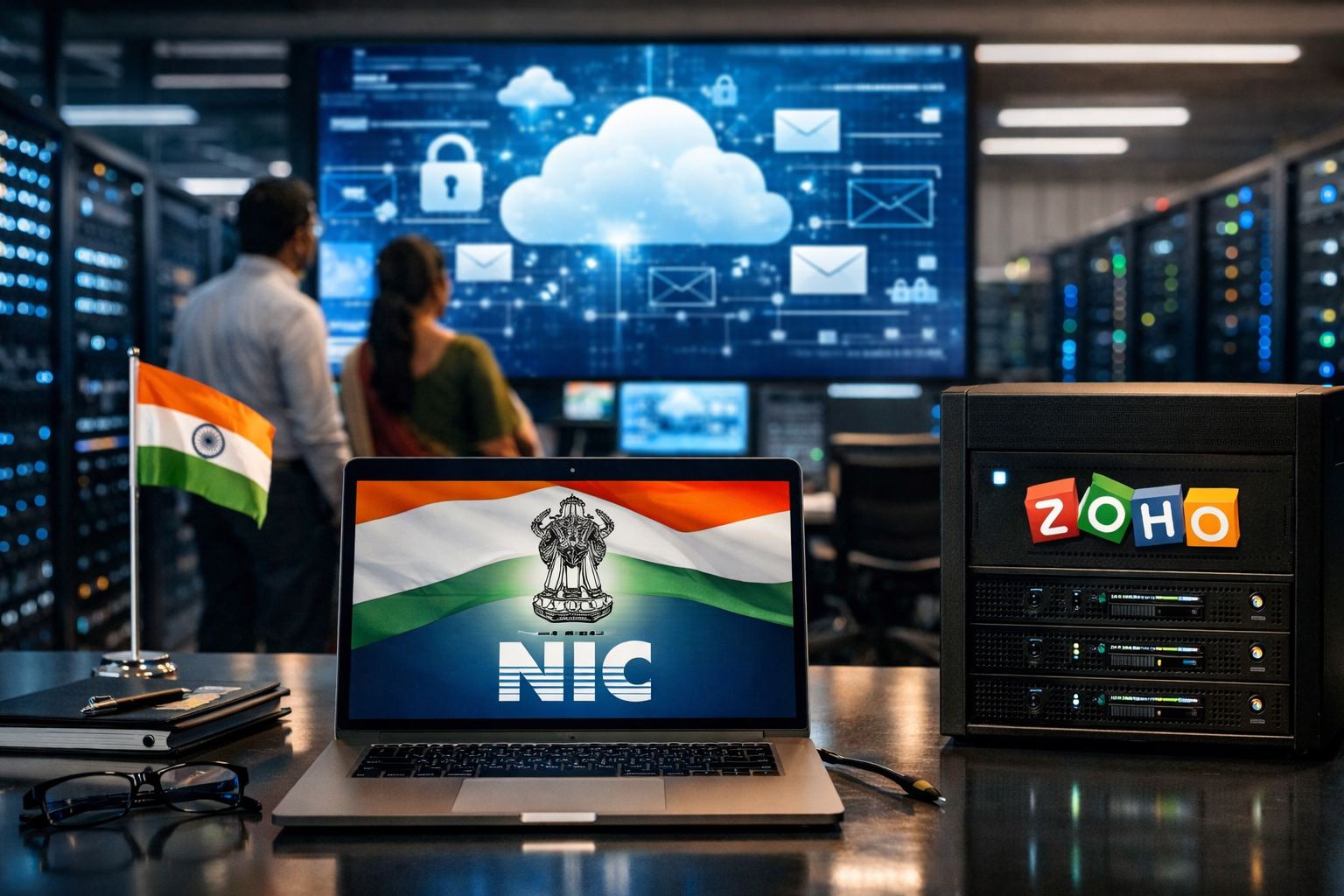
In a major step toward strengthening India’s digital infrastructure, the central government has migrated over 16.68 lakh official email accounts to a cloud-based platform operated by Zoho Corporation. The total expenditure on the project has reached approximately ₹180.10 crore so far.
The move, confirmed in Parliament by the Ministry of Electronics and Information Technology, is being positioned as part of a broader effort to build a secure, sovereign, and scalable communication system for government use.
While the headline numbers are significant, the deeper story lies in how the system is structured and why this shift matters beyond just a technical upgrade.
What Exactly Has Changed
The migration covers email accounts used by central government ministries and departments. These accounts are now being supported by a cloud-based infrastructure, replacing older legacy systems that were limited in scalability and modern security capabilities.
The implementation is being handled by the National Informatics Centre (NIC), which continues to manage and operate official email services. Zoho has been brought in as the Master System Integrator, meaning it provides the underlying cloud platform rather than directly controlling government communications.
This distinction is important. The government has not outsourced its email system. Instead, it has adopted a hybrid model where infrastructure is upgraded while operational control remains internal.
Cost Breakdown and Pricing Model
The financial structure of the project is based on a per-user pricing system rather than a fixed contract value.
| Component | Details |
|---|---|
| Total accounts migrated | 16.68 lakh |
| Total expenditure | ₹180.10 crore |
| Monthly cost per account | ₹170 to ₹300 |
| Storage per account | 30GB to 100GB |
Payments are directly linked to the number of accounts migrated. This means the total cost may continue to rise as more departments transition to the platform.
From a cost perspective, the model allows flexibility while aligning spending with actual usage.
Read More: Your Email Login Doesn’t Expire? Here’s the Truth
Why the Government Made This Move
According to official statements, the primary goal is to create a secure and sovereign email system for government communication.
This includes ensuring full ownership and control of data remains with the Government of India, reducing dependency on external or foreign infrastructure, improving scalability for growing digital communication needs, and strengthening cybersecurity capabilities.
The initiative also aligns with the broader Make in India push, which prioritises domestic technology providers for critical infrastructure.
How Zoho Was Selected
The selection of Zoho was not a direct appointment. It followed a structured procurement process.
The bidding was conducted through the Government e-Marketplace (GeM-CPPP), multiple vendors were evaluated, and a Proof of Concept (PoC) was conducted with shortlisted participants and government users.
Only after meeting technical and security requirements defined by NIC was Zoho finalised as the Master System Integrator.
This process adds a layer of transparency and technical validation to the project.
Security Architecture and Safeguards
The upgraded system includes multiple layers of security designed to address modern cyber threats.
Key features include encryption of email data both at rest and during transmission, Multi-Factor Authentication (MFA) for user access, integration with NIC’s security monitoring systems, and advanced threat protection mechanisms against phishing and malware.
Additionally, the system is required to maintain disaster recovery infrastructure across geographically separated locations to minimise data loss during disruptions.
However, it is important to note that no system can completely eliminate cyber risks. Security also depends heavily on how users handle access and follow basic digital practices.
The Bigger Picture: More Than Just an Email Upgrade
This migration is not just about improving email services. It reflects a broader shift in how India is approaching digital infrastructure.
Instead of relying entirely on global platforms, the government is moving toward a model that combines domestic technology providers, government-controlled operations, and cloud-based scalability.
This approach can be described as a sovereign cloud model, where control and infrastructure are strategically balanced.
It also signals a long-term focus on reducing external dependencies in critical communication systems.
What This Means Going Forward
As more departments are expected to transition, the scale and cost of the project may increase. At the same time, the effectiveness of the system will depend not just on technology, but also on implementation and user behaviour.
Experts have repeatedly pointed out that human error remains one of the biggest cybersecurity risks, even in advanced systems. This makes employee awareness and digital hygiene an essential part of the overall strategy.
Final Takeaway
The migration of over 16.68 lakh government email accounts to a cloud platform marks one of the largest digital infrastructure upgrades in India’s public sector.
By combining the capabilities of Zoho Corporation with the operational control of the National Informatics Centre, the government is attempting to build a system that is both modern and sovereign.
While the long-term impact will depend on execution, the shift clearly indicates a strategic move toward more secure, scalable, and self-reliant digital systems.
Also Read: Locked Out of Your X Account Without Email or Phone? Here’s What You Can Try